- Source pack and brief
- AI-assisted draft
- Expert checks evidence
- Editor prepares publication
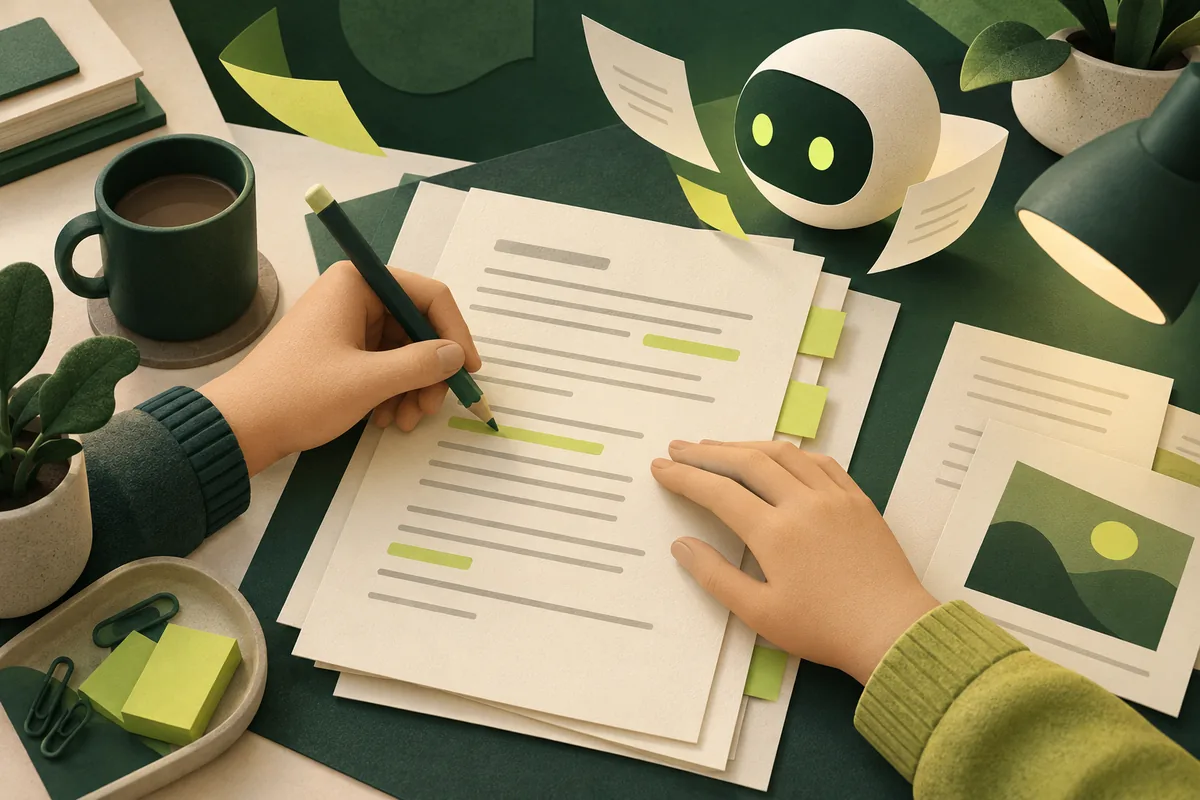
StackBrief workflow illustration. A suggested process, not a recorded product test.
The draft is grammatically fine. It also sounds like every other article about your industry. For a B2B marketing team, that is the common failure to solve: a page can read smoothly while giving a buyer no new reason to trust it.
A better AI content workflow starts before the first paragraph. Give the writer a specific reader, a decision to help with, and material that belongs to your business. AI can help organize and rewrite that material; it cannot supply customer experience your team never documented.
Start with the question behind the keyword
Consider an illustrative company selling help-desk software. “AI customer support” is a broad topic. “How should a five-person support team approve AI-drafted replies?” describes a reader and a practical decision. The second brief makes it easier to decide what belongs on the page.
Write a one-sentence answer before creating an outline. For this example: route routine drafts to a reviewer, keep uncertain requests visible, and measure correction time before expanding. That sentence is a proposed workflow, not a claim that a particular product already performs it successfully.
Build a source pack the writer can use
Collect approved product documentation, dated pricing notes, a subject expert’s answers, and permission-cleared examples. Mark each item as a verified fact, an opinion, or an illustration. Keep confidential customer details out of the pack unless their use has been approved.
Ask the expert where buyers get confused. A specific explanation of why two support queues must stay separate is more useful than a paragraph about transforming customer experiences. If you do not have original data, publish a clearly labeled worked example instead of inventing a case study.
Give the model a bounded assignment
A useful draft instruction might be: “Write for a support manager at a small US software company. Explain the approval workflow using only the supplied notes. Label the example as hypothetical. Flag unsupported product claims instead of filling them in. Use short paragraphs and concrete verbs.”
Request an outline first if the source material is messy. Remove sections that merely restate the introduction. Then draft one section at a time where an expert needs to check technical accuracy. This keeps a polished but unsupported statement from becoming the premise for the whole article.
Edit for a person with a real problem
Read the draft as the manager who must implement it on Monday. Who approves the response? Where do unclear cases go? What happens when the reviewer is away? Replace vague encouragement with answers to those questions.
Here is an illustrative edit. Before: “Leverage AI to streamline your customer engagement strategy.” After: “Let AI prepare a reply, then have the queue owner check the account details before sending it.” The second sentence gives the reader an action, an owner, and a boundary.
Natural writing does not require slang, deliberate mistakes, or an invented personal anecdote. Vary sentence length when the explanation calls for it, use familiar language, and keep technical terms when they are more precise. Remove any sentence that sounds impressive but changes no decision.
Add SEO without making the page repetitive
Use a descriptive title, one clear main heading, and section headings that help readers find answers. Write a distinct meta description that accurately previews the article. Link to related pages when they answer the next question, rather than inserting the same keyword into every paragraph.
Google’s guidance on AI-assisted content emphasizes accuracy, quality, and relevance, and warns against producing many pages without adding value. It also applies that care to titles, descriptions, and image alt text. Source: Google Search guidance on generative AI content.
Use visuals to explain, not to imply proof
A workflow diagram can show where review occurs. A permission-cleared screenshot can demonstrate a real setting. An editorial illustration can make a text-heavy page more inviting, but it should not be presented as a product screenshot or evidence of a test.
Write alt text that describes the relevant image content without stuffing search phrases into it. Put important figures and instructions in ordinary page text as well, so readers do not have to interpret an image to follow the advice.
Make the final review specific
| Reviewer | Question to resolve |
|---|---|
| Subject expert | Are the claims accurate and the example realistic? |
| Editor | Does each section help the stated reader make progress? |
| Publisher | Do links, dates, image descriptions, and metadata match the page? |
After publication, collect questions from readers or your sales team. Improve the page when those questions reveal a missing explanation. If you are choosing software for this process, start with our Jasper vs Writer comparison and marketing AI shortlist. The workflow should determine the tool, not the other way around.